
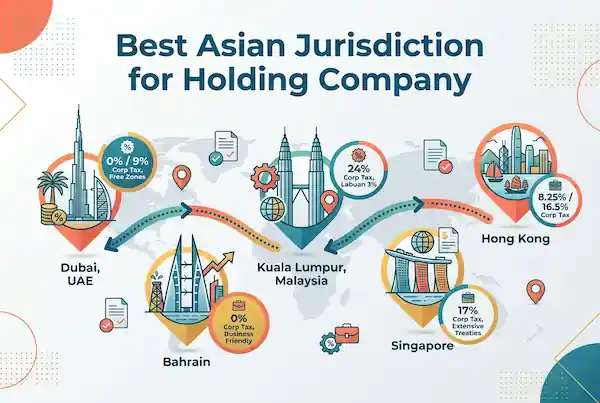
Choosing the Optimal Asian Jurisdiction for a Holding Company
Last updated: May 20 2026
When investors and multinational groups look to establish a holding company in Asia, the decision hinges on tax efficiency, regulatory stability, ease of administration, and access to capital markets. Below is a concise, expert‑level guide that outlines the most attractive jurisdictions, the key factors to evaluate, and practical steps to get started.
1. Why Asia Is a Hub for Holding Structures
- Strategic location – Proximity to fast‑growing economies such as China, India, and Southeast Asia gives holding companies quick access to emerging markets.
- Favourable tax regimes – Many Asian countries offer low or zero corporate tax on foreign‑sourced income, extensive treaty networks, and incentives for holding activities.
- Robust legal frameworks – Modern company laws, transparent courts, and strong protection of minority shareholders create a predictable environment for investors.
2. Top Asian Jurisdictions to Consider
| Jurisdiction | Key Advantages | Common Holding Structures | Foreign Income / Tax Treatment |
|---|---|---|---|
| Singapore | World‑class financial hub, extensive double‑tax treaties, no capital gains tax, stable political climate | Private Limited (Pte Ltd) holding company, Variable Capital Company (VCC) | Conditional exemption possible |
| Hong Kong | Simple tax system, robust rule‑of‑law, easy incorporation | Private Company Limited by Shares | 0 % on offshore profits |
| Malaysia (Labuan IBFC) | Competitive tax incentives, strategic location | Labuan company, Berhad (Bhd) | 3 % effective tax on Labuan entities |
| UAE – DIFC | Zero corporate tax, full foreign ownership, strong regulatory oversight | DIFC‑registered Holding Company | 0 % |
3. Singapore: The Gold Standard
Singapore is commonly considered for holding company structures because of its legal stability, business reputation, treaty network, and efficient corporate framework. The country’s single‑tier corporate tax system, no withholding tax on dividends paid to non‑resident shareholders, and its extensive network of over 80 tax treaties provide unparalleled treaty protection.
To set up a Singapore holding company, you will need to:
- Reserve a company name – ensure it complies with ACRA guidelines.
- Appoint at least one local director – while 100 % foreign ownership is permissible, a resident director can be a nominee service.
- Prepare incorporation documents – constitution, director and shareholder resolutions, and a registered office address.
- File with ACRA – the incorporation process can be completed online within one business day.
For a step‑by‑step walkthrough, see the detailed guide on registering a company in Singapore. https://terraadvisoryservices.com/how-to-register-a-company-in-singapore/
4. Comparative Factors for Decision‑Making
| Factor | Singapore | Hong Kong | Malaysia (Labuan) | UAE (DIFC) |
|---|---|---|---|---|
| Incorporation time | 1 day | 2–3 days | 1 week | 1 week |
| Minimum capital | S$1 (≈ US$0.75) | HK$1 | US$1 | US$1 |
| Annual filing | Simple declaration | Simple return | Annual return & audit | Annual return |
| Substance requirements | Commercial substance expectations may be relevant depending on structure and tax treatment | Economic substance (if applicable) | Substantial economic substance needed | Substantial substance (office, staff) |
| Compliance cost | Low | Moderate | Low‑moderate | Moderate‑high |
5. Ownership Structures for Foreign Investors
Foreign entrepreneurs often ask whether they can own 100 % of a Singapore company. The answer is affirmative; a foreigner may hold all shares, provided a local director is in place—typically a nominee service. Detailed guidance on foreign ownership is available here. https://terraadvisoryservices.com/can-a-foreigner-own-100-of-a-singapore-company/
6. Choosing the Right Business Structure
The optimal corporate form depends on your operational needs, financing plans, and exit strategy. For startups and tech ventures, a Variable Capital Company (VCC) offers flexibility in capital management, while a traditional Private Limited provides simplicity and credibility. A comparative analysis of Singapore business structures for 2026 can help you decide. https://terraadvisoryservices.com/best-singapore-business-structure-startups-2026/
7. Cross‑Border Registration Options
If your holding company will operate across multiple Asian markets, you may consider establishing a foreign business registration in each target country. This approach enables you to benefit from local incentives while maintaining a central holding entity. An overview of foreign business registration options is provided here. https://terraadvisoryservices.com/foreign-business-registration-options/
8. Practical Tips for Ongoing Compliance
- Maintain proper accounting records – even with zero tax, annual financial statements must be filed.
- Review commercial substance expectations – management location, board control, records, and business activity should align with the intended structure and tax position.
- Stay updated on treaty changes – double‑tax treaties are periodically renegotiated; monitor updates to protect your tax position.
Considering a Singapore holding company? If you need guidance on company structure, foreign ownership, or cross-border incorporation planning, explore our Singapore incorporation services.
Frequently Asked Questions
What is the most tax-efficient Asian jurisdiction for a holding company?
Singapore is commonly considered for Asian holding structures because of its stable legal framework, treaty network, no capital gains tax, and business reputation. However, the most suitable jurisdiction depends on ownership structure, income flows, tax residency, and commercial objectives.
Can a foreigner own 100% of a Singapore holding company?
Yes. Foreign investors may hold 100% of the shares in a Singapore company, provided at least one Singapore resident director is appointed.
Do I need a physical office in Singapore?
Commercial substance expectations depend on the company structure, tax treatment, business activity, and regulatory context. Businesses should assess management control, records, and operational substance carefully.
How long does it take to incorporate a Singapore holding company?
In many standard cases, incorporation can be completed within one business day once all required documents are ready and approvals are in place.
Are there annual filing requirements?
Yes. Singapore companies must meet ongoing compliance obligations, including annual filings, accounting record maintenance, and tax reporting where applicable.