
Last updated: 19 Mar 2026
Guide to Registering A company in singapore 2026
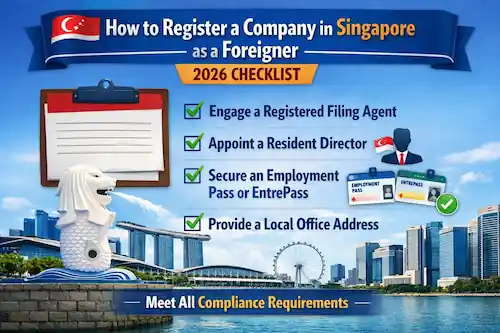
Short answer: Yes, foreigners can register a company in Singapore with 100% ownership—but you must appoint at least one locally resident director and usually work with an ACRA-registered filing agent to submit incorporation via BizFile+. This guide walks you through the exact steps, documents, and post-incorporation compliance so you avoid costly delays. Need help? Get a free consultation from our ACRA-registered team.
Singapore remains one of the world's most founder-friendly jurisdictions for foreign entrepreneurs. With no restrictions on foreign shareholding, a transparent regulatory framework, and access to ASEAN markets, it's no surprise that thousands of overseas founders incorporate here each year. But the process has two non-negotiable requirements that trip up many applicants: (1) your company must have at least one locally resident director, and (2) if you're incorporating from overseas or lack local digital IDs, you'll typically need an ACRA-registered corporate service provider to lodge your application via BizFile+. ACRA explains the local residency requirement here.
This 2026 guide cuts through the complexity. We'll cover the exact steps to incorporate, what "locally resident director" really means, how to avoid the most common mistakes, and what to do after incorporation so you don't get stuck on tax, banking, or compliance. Whether you're in the US, Europe, Australia, or anywhere else, this is your practical roadmap.
What Foreign Founders Need to Know First
Most foreigners successfully incorporate a Singapore private limited company by following this proven sequence:
- Reserve your company name via ACRA's BizFile system (some names approve instantly; others require manual review).
- Prepare core documents: passport copies, proof of residential address, shareholding breakdown, and a clear business activity description.
- Appoint key officers, especially a locally resident director—this is the most common bottleneck for foreign founders.
- Engage an ACRA-registered filing agent to lodge the incorporation via BizFile+ (required for most overseas applicants).
- Complete post-incorporation setup: appoint a company secretary within 6 months, set up tax filings, and establish your compliance calendar.
Missing any of these steps can delay your incorporation or trigger compliance penalties later. The two most critical legal requirements for foreigners are the locally resident director rule and the 6-month deadline to appoint a company secretary. ACRA's officer appointment requirements are here.
What This Guide Covers
- 2026 Requirements Checklist for Foreign Founders
- Step-by-Step Incorporation Process
- Locally Resident Director: What It Really Means
- Company Secretary Rules (The 6-Month Deadline)
- Post-Incorporation: Compliance & Tax You Can't Skip
- Corporate Bank Account Tips for Foreign-Owned Companies
- Employment Pass Options for Foreign Founders
- Common Mistakes (and How to Avoid Them)
- Frequently Asked Questions
2026 Requirements Checklist for Foreign Founders
Foreigners can own 100% of a Singapore company and serve as directors—but the company must still have at least one director who is a locally resident of Singapore. ACRA: local residency requirement.
Here's what you need to prepare, in plain English:
| Requirement | What It Means | Why It Matters |
|---|---|---|
| At least 1 locally resident director | A director who is a Singapore citizen, Permanent Resident, or holder of an Employment Pass/EntrePass/S Pass. | Without this, ACRA will not approve your incorporation. This is the most common hurdle for foreign founders. |
| Director eligibility | Directors must be at least 18 years old, of full legal capacity, and not disqualified under the Companies Act. | Incorrect appointments cause delays and can trigger compliance reviews. |
| Company secretary within 6 months | A locally resident, qualified individual must be appointed as company secretary within 6 months of incorporation. | Missing this deadline risks fines and administrative penalties. The sole director cannot also serve as secretary. |
| ACRA-registered filing agent (often required) | Foreign founders incorporating from overseas typically need a licensed corporate service provider to submit via BizFile+. | Prevents "blocked" incorporations where you cannot submit filings yourself due to lack of Singpass/CorpPass. |
| Ongoing tax & compliance filings | Companies must file Estimated Chargeable Income (ECI) and Form C-S/C annually, even if inactive (unless waived). | Tax non-filing triggers IRAS notices, penalties, and downstream banking or licensing issues. |
Official references: ACRA local residency rules and ACRA officer appointment rules.
Step-by-Step: How Foreigners Incorporate a Singapore Company
Step 1: Reserve Your Company Name
Submit your proposed company name via ACRA's BizFile+ system. Many names are approved within hours, but some require manual review if they contain restricted words (e.g., "bank," "university," "government") or closely resemble existing entities. Pro tip: align your name with your intended business activity to reduce review risk.
Step 2: Prepare Your Incorporation Details
Gather these items early to avoid delays:
- Clear passport copy for each foreign shareholder/director (valid, color, all pages)
- Recent proof of residential address (utility bill, bank statement—dated within 3 months)
- Shareholding breakdown (who owns what percentage, in SGD or foreign currency)
- Clear business activity description (use ACRA's SSIC code search to find the right classification)
- Company constitution (most use ACRA's standard Model Constitution unless custom provisions are needed)
Step 3: Appoint Key Officers
All Singapore companies must appoint at least one director and a company secretary. For foreign founders, the locally resident director requirement is often the most complex step. ACRA provides detailed guidance on nominee director concepts and officer endorsements. ACRA: appointing directors and company secretary.
If you need a compliant local director setup, read: Nominee director in Singapore: what it is and when you need it.
Step 4: Lodge Incorporation via an ACRA-Registered Filing Agent
If you're incorporating from overseas or lack Singpass/CorpPass access, you'll typically work with an ACRA-registered corporate service provider (CSP) who submits your application via BizFile+ on your behalf. ACRA notes that foreigners who wish to relocate to manage their company must seek MOM approval after incorporation. ACRA: foreign founders + CSP filing.
Working with a licensed CSP like Terra Advisory Services ensures your application is complete, compliant, and submitted correctly the first time—avoiding costly rejections or delays.
Step 5: Complete Post-Incorporation Setup (Don't Skip This)
The real risk isn't the incorporation itself—it's what happens next. Many foreign founders focus on getting the company registered, then underestimate the ongoing compliance workload: statutory records, tax filings, annual returns, and regulatory updates. If you want a full governance view, use: Singapore corporate compliance 2026.
Locally Resident Director: What Foreign Founders Must Know (2026)
For a local company, ACRA requires at least one locally resident director. If you live outside Singapore, you must appoint someone who qualifies as locally resident to meet this requirement. ACRA: requirements for local residency.
Who qualifies as "locally resident"? Typically:
- Singapore citizens
- Singapore Permanent Residents (PRs)
- Employment Pass (EP), EntrePass, or S Pass holders (with valid work pass)
ACRA also emphasizes that all directors—resident or not—bear legal responsibility for company compliance. There is no "sleeping director" exemption under the Companies Act. ACRA: director duties and requirements.
If you need a compliant local director setup, read: Nominee director in Singapore: what it is and when you need it.
Company Secretary Rules (The 6-Month Deadline)
In Singapore, a company must appoint a company secretary within 6 months from incorporation. The secretary must be locally resident and qualified. Critically, if your company has only one director, that person cannot also serve as the company secretary. ACRA: company secretary requirements.
What does a company secretary actually do? They maintain statutory registers, prepare board resolutions, file annual returns with ACRA, and ensure ongoing compliance with the Companies Act. For a plain-English view of secretarial duties, use: Singapore corporate secretarial services guide or browse: corporate secretarial services.
After Incorporation: Compliance & Tax You Can't Skip
1) Corporate Tax Filing (IRAS)
IRAS requires companies to file two corporate income tax returns each year:
- Estimated Chargeable Income (ECI) within 3 months after financial year end (unless waived)
- Form C-S / Form C-S (Lite) / Form C by 30 November
IRAS: basic guide to corporate income tax for companies.
Importantly, IRAS states your company must still file the annual return even if it did not carry on business or is loss-making, unless a filing waiver has been granted. IRAS: filing still required even with no business.
For a full 2026-ready setup plan, you can link out to: Singapore company tax compliance checklist for 2026 and Singapore accounting requirements 2026.
2) Statutory Records and Annual Compliance
If you want to avoid "surprise" compliance work later, build your basic compliance stack early: directors' resolutions, statutory registers, a filing calendar, and a reliable secretarial process. Use: Singapore corporate compliance 2026.
Opening a Corporate Bank Account (Foreign-Owned Companies)
Banks often request clearer substance and documentation for foreign-owned companies. Prepare a clean pack: group structure chart, sample contracts or invoices (if any), a clear business model description, source of funds documentation, and details of who will be authorized signatories. To avoid delays, ensure your incorporation details and business activity narrative are consistent with your banking story.
Many foreign founders find that working with a CSP that has established banking relationships streamlines this process significantly.
Employment Pass (EP) Options for Foreign Founders
If you plan to relocate to Singapore to run your business day-to-day, you'll need the right work pass—often an Employment Pass (EP). ACRA notes that foreigners who wish to relocate to manage a company must seek MOM approval after incorporation. ACRA: foreign founders relocating + MOM approval context.
Related internal reading: Employment Pass (EP) in Singapore.
Common Mistakes Foreign Founders Make (and How to Avoid Them)
- Leaving the locally resident director to the last minute → Causes stalled incorporation. Solution: Engage a nominee director service early in the process.
- Weak or mismatched business activity description → Triggers name/application review delays. Solution: Use ACRA's SSIC code search and align your description with your actual activities.
- Forgetting the 6-month secretary deadline → Creates compliance breach risk. Solution: Set a calendar reminder and appoint a secretary during incorporation if possible.
- Ignoring tax filing duties → IRAS filing still applies even if no revenue (unless waived). Solution: Build tax compliance into your post-incorporation checklist from day one.
- Treating directorship as "sleeping" → ACRA notes the law does not distinguish sleeping directors; all directors bear legal responsibility. Solution: Stay informed or delegate compliance to a trusted CSP.
The official rule points for directors and secretaries are summarised by ACRA here: ACRA: appointing directors/company secretary + responsibilities.
Need Help Incorporating as a Foreigner?
If you want this done end-to-end—incorporation, resident director/nominee director setup where appropriate, company secretary appointment, accounting, and compliance calendar—start here:
Company incorporation services or contact the Terra Advisory team for a free, no-obligation consultation.
Frequently Asked Questions
Can a foreigner own 100% of a Singapore company?
Yes. ACRA states foreigners residing overseas can own shares in a Singapore-registered company with no restrictions on foreign shareholding. You still need at least one locally resident director for a local company. Source: ACRA.
Do I need a locally resident director if I live overseas?
Yes. ACRA requires a local company to have at least one locally resident director. Foreign entrepreneurs residing overseas must appoint one to manage the company or business. Source: ACRA.
When must I appoint a company secretary?
ACRA states companies must appoint a company secretary within six months from the date of incorporation, and the secretary must be locally resident in Singapore. Source: ACRA.
Can the sole director also be the company secretary?
No. ACRA states the sole director of a company and the company secretary cannot be the same person. Source: ACRA.
Do I still need to file corporate tax if my company has no revenue?
Yes. IRAS states companies must file Form C-S / Form C-S (Lite) / Form C by 30 November even if the company did not carry on business or is in a loss position, unless a waiver is granted. Source: IRAS.
What are the two main corporate tax filings each year?
IRAS states companies generally file (1) Estimated Chargeable Income (ECI) within three months after the financial year end (unless waived) and (2) Form C-S / Form C-S (Lite) / Form C by 30 November. Source: IRAS.
If I hold a FIN (EP/EntrePass), can I be a director?
ACRA advises FIN holders to check with the relevant pass-issuing authority on their eligibility before accepting an appointment as director. EP holders may need MOM consent for secondary directorships. Source: ACRA.
Is a "sleeping director" safe?
No. ACRA states the law does not distinguish between active and sleeping directors; directors remain responsible for offences and compliance. Source: ACRA.
Disclaimer: This article is for general information only and is not legal, tax, or immigration advice. Confirm details with the relevant authorities and/or professional advisors.