
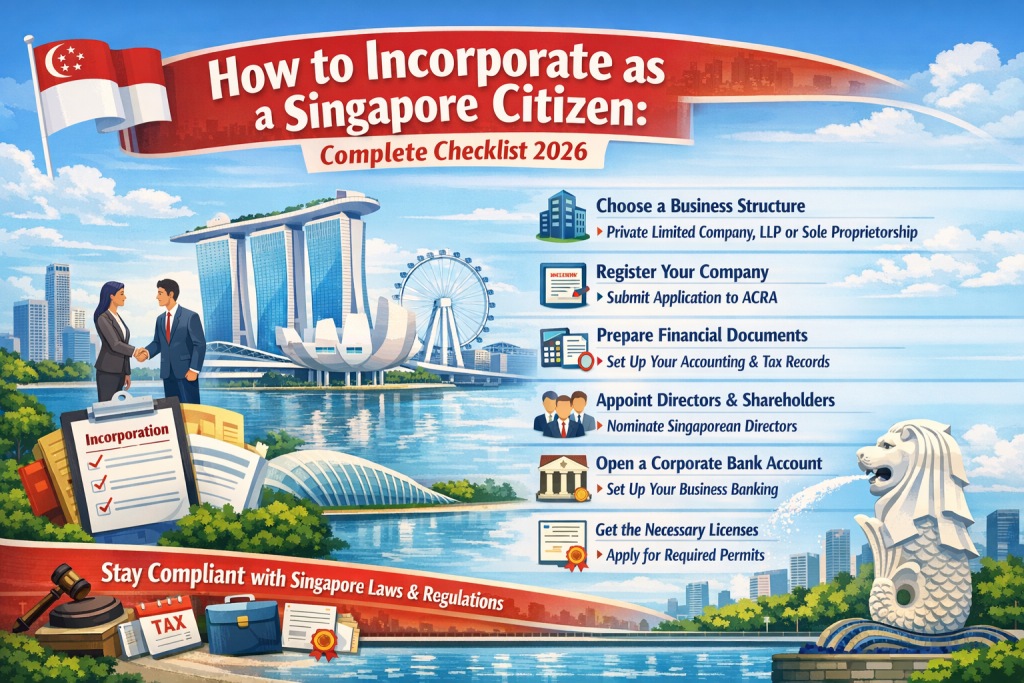
Incorporating a company as a Singapore citizen is one of the most straightforward business processes in the world. Singapore's efficient registration system, combined with attractive tax benefits and government support, makes it an ideal choice for local entrepreneurs. This quick-reference checklist covers everything you need to know—from eligibility requirements to post-incorporation compliance. For a comprehensive deep-dive, see our guide to company incorporation in Singapore.
Why Incorporate as a Singapore Citizen?
- Limited liability protects personal assets.
- Tax efficiency – qualifying private-limited companies enjoy a 17% corporate tax rate with partial exemptions and no tax on dividends.
- Access to government grants such as Startup SG, ACE, and the Productivity Solutions Grant, which are reserved for Singapore-registered entities.
- Credibility with local partners, banks, and investors.
- 2026 Benefits: The Singapore Budget 2026 includes a 40% corporate tax rebate (up to S$30,000), making this an ideal time to incorporate.
Eligibility & Residency Rules
| Requirement | Detail |
|---|---|
| Director | At least one director must be a Singapore citizen or permanent resident. Other directors can be foreigners. |
| Shareholder | No nationality restriction; a Singapore citizen can hold 100% of the shares. |
| Company Secretary | Must be a qualified secretary who is a Singapore resident (citizen/PR or an entity with a local office). |
| Registered Office | Must be a physical Singapore address (cannot be a PO box). |
| Age | Directors must be at least 18 years old. |
For detailed requirements specific to 2026, see our article on Singapore company incorporation requirements for 2026.
Step-by-Step Incorporation Process
| Step | Action | Key Resources |
|---|---|---|
| 1. Choose a Company Name | Verify availability on BizFile+; reserve for up to 60 days. | BizFile+ portal |
| 2. Prepare Required Documents |
|
Templates on the ACRA site |
| 3. Register Online via BizFile+ | Log in, select "Register a Business," upload documents, and pay the registration fee (S$315 for a private limited). | BizFile+ portal |
| 4. Appoint a Company Secretary | Must be appointed within 6 months of incorporation. | Local secretarial firms |
| 5. Open a Corporate Bank Account | Provide incorporation certificate, ACRA business profile, and ID of signatories. | Major banks (DBS, OCBC, UOB) |
| 6. Register for GST (if applicable) | Mandatory if annual turnover > S$1 million; optional otherwise. | IRAS GST portal |
| 7. Obtain Necessary Licences | Industry-specific licences (e.g., food, finance) must be applied for separately. | Relevant regulatory bodies |
Typical timeline: 1–2 weeks from name reservation to issuance of the Certificate of Incorporation, assuming all documents are complete.
Costs & Fees
| Item | Approximate Cost (S$) |
|---|---|
| Name reservation | 15 |
| Registration fee (private limited) | 315 |
| Company secretary (first year) | 600–1,200 |
| Statutory audit (if required) | 1,500–3,000 |
| GST registration (optional) | No fee |
| Bank account opening | Varies; usually no charge |
Additional costs may arise for licences, trademark registration, or professional services.
Tax & Compliance Benefits
- Partial tax exemption: First S$10,000 of chargeable income taxed at 0%; next S$190,000 at 8.5%.
- No dividend tax: Distributions to shareholders are tax-free.
- Corporate tax rebates for new start-ups (up to S$30,000 in the first three years).
- Annual filing: Submit Annual Return (within 30 days of AGM) and Tax Return (Form C-S) to IRAS.
Government Grants & Incentives for Singaporean Entrepreneurs
| Scheme | Eligibility | Benefit |
|---|---|---|
| Startup SG Founder | Singapore citizen, innovative business idea | Up to S$30,000 mentorship and funding |
| ACE (Enterprise Development Grant) | Companies with ≥30% local shareholding | Up to 70% of qualifying project costs |
| Productivity Solutions Grant | Adoption of approved tech solutions | Up to 80% of costs, capped at S$30,000 |
| Tech Access Programme | Tech-focused start-ups | Free access to cloud services and tools |
Apply through Enterprise Singapore or the respective agency's portal.
Common Pitfalls & How to Avoid Them
- Incomplete director consent – always obtain a signed consent form before submission.
- Using a PO box as registered address – a physical office is mandatory; consider a virtual office with a physical mailbox.
- Delaying appointment of a company secretary – penalties apply if not appointed within 6 months. Ensure you understand post-incorporation compliance requirements.
- Missing annual filing deadlines – set calendar reminders; engage a corporate service provider to handle compliance.
Frequently Asked Questions
- Can a Singapore citizen own 100% of a private limited company?
- Yes. There is no restriction on shareholding percentage for locals.
- Do I need a local director if I'm a Singapore citizen?
- At least one director must be a Singapore citizen or permanent resident; the remaining directors can be foreign.
- How long does incorporation take?
- Typically 1–2 weeks, provided all documents are correct and the name is approved.
- What are the ongoing compliance costs?
- Annual return filing (≈ S$30) plus possible audit fees (S$1,500–3,000) and secretarial fees (S$600–1,200).
- Are there tax advantages for Singaporean entrepreneurs?
- Yes – partial tax exemption, no tax on dividends, and various rebates for new start-ups. Consider the best Singapore business structure for your startup to maximize these benefits.
- What business structure should I choose?
- Private Limited Company (Pte Ltd) is most common for tax efficiency and credibility. See our guide on business structures for startups.
Quick Checklist for Singapore Citizens
- Verify and reserve company name on BizFile+.
- Gather director consent, NRIC copies, and address proof.
- Submit incorporation application and pay S$315 fee.
- Appoint a qualified Singapore-resident company secretary within 6 months.
- Open a corporate bank account.
- Register for GST if turnover > S$1 million.
- Apply for relevant licences and government grants.
- Mark calendar for annual return and tax filing deadlines.
Following this guide will help Singaporean entrepreneurs incorporate efficiently, stay compliant, and take full advantage of local tax benefits and grant programmes.
Ready to incorporate? Read our complete guide to company incorporation in Singapore for step-by-step assistance and expert guidance.