
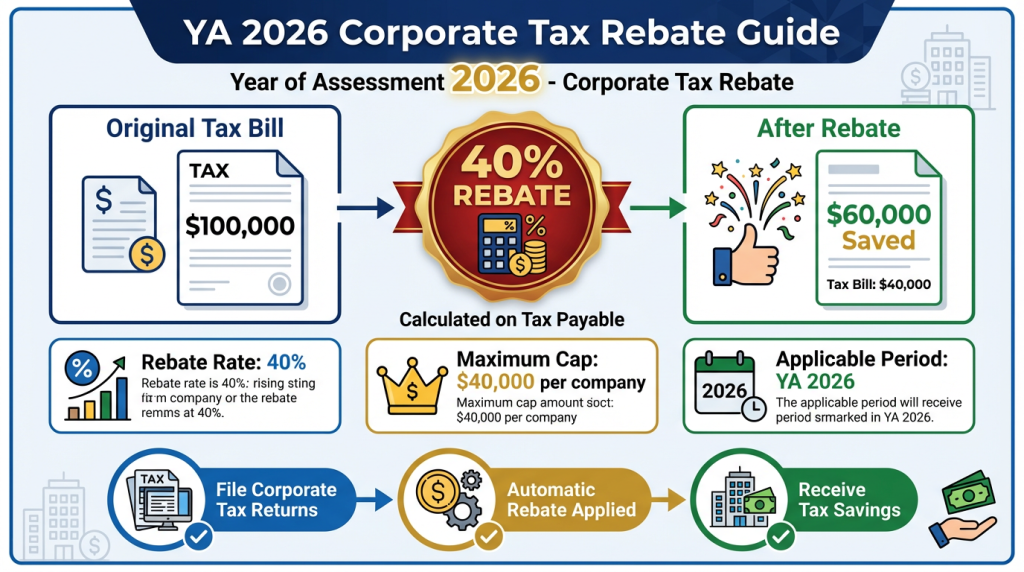
Tax season is approaching. For business owners preparing for Singapore Corporate Tax YA 2026, there is significant relief ahead. The government has announced a new 40% Corporate Income Tax (CIT) Rebate to help companies manage rising business costs. However, strict deadlines remain in place, and missing them can lead to fines.
This guide explains exactly what you need to know for YA 2026. We cover the new rebate, filing dates, and how to stay compliant.
1. The New 40% Corporate Tax Rebate
The biggest update for YA 2026 is the enhanced tax rebate. This is designed to support businesses facing higher operating costs.
Key Details of the Rebate:
- Rebate Rate: 40% of your corporate tax payable.
- Maximum Cap: The rebate is capped at S$30,000.
- Cash Grant Option: Companies that employed at least one local worker in 2025 will receive a minimum cash payout of S$2,000, even if they do not pay any tax.
What this means for you: Most SMEs will pay significantly less tax this year. If your company is profitable, this rebate directly reduces your cash outflow. If your company is loss-making but hired local staff, you still get cash support.
2. Critical Deadlines for Singapore Corporate Tax YA 2026
Singapore has two main filing deadlines. You must meet both to avoid penalties from IRAS.
| Filing Type | Deadline | Who Must File? |
|---|---|---|
| ECI (Estimated Chargeable Income) | 3 Months after FYE | All companies (unless waived*) |
| Form C-S / Form C | 30 November 2026 | All companies |
*Waiver applies if Revenue < S$5 million AND ECI is Nil.
Estimated Chargeable Income (ECI)
You must file your ECI within 3 months after your Financial Year End (FYE). Filing early can allow you to pay your tax in installments, which helps with cash flow management.
Form C-S / Form C
The final tax return is due by 30 November 2026. Paper filing is no longer allowed; you must file electronically via the myTax Portal.
3. Common Mistakes to Avoid
Filing taxes can be tricky. Here are three common errors we see at Terra Advisory Services:
- Wrong Financial Year: Ensure you are filing for the correct basis period. For YA 2026, you are taxed on income earned in your financial year ending in 2025.
- Ignoring Foreign Income: If you received income from overseas, it might be taxable. However, exemptions apply if the money was already taxed abroad.
- Missing Deductions: Don’t forget to claim capital allowances for equipment and the 400% tax deduction for AI and innovation under the Enterprise Innovation Scheme (EIS).
4. Cross-Border Compliance: The Malaysia Connection
Many Singapore firms have subsidiaries in Malaysia. If you do, you must also watch your compliance across the border.
Our Malaysia affiliate, JT & CY Advisory, reports that the Audit Exemption threshold in Malaysia has increased to RM 1 Million for 2026. This is a major opportunity. If your Malaysian subsidiary qualifies, you can save on audit fees and simplify your group reporting.
Frequently Asked Questions (FAQ)
1. How much is the Singapore Corporate Tax Rebate for YA 2026?
For YA 2026, the rebate is 40% of the corporate tax payable, capped at S$30,000. Companies that employed at least one local worker in 2025 will receive a minimum cash payout of S$2,000.
2. When is the deadline for Form C-S in 2026?
The deadline for filing Form C-S, Form C-S (Lite), and Form C for YA 2026 is 30 November 2026. All filings must be done electronically via the myTax Portal.
3. Do I need to file tax if my company made a loss?
Yes. Even if your company made a loss or has no income, you must still file a tax return. For dormant companies, you may apply for a waiver of Income Tax Return submission.
4. Can I get the S$2,000 cash payout if I pay zero tax?
Yes. The minimum cash payout of S$2,000 is designed to help smaller companies. As long as you employed at least one local worker (Singapore Citizen or PR) in 2025 and made CPF contributions, you are eligible for the cash payout even if your tax bill is zero.
5. Does the 40% rebate affect my Start-Up Tax Exemption (SUTE)?
No. The 40% Corporate Income Tax Rebate is applied after the Start-Up Tax Exemption (SUTE) or Partial Tax Exemption (PTE) is deducted. This means you get the benefit of the exemption first, and then the rebate reduces your remaining tax bill.
6. What happens if I miss the ECI deadline?
If you miss the ECI deadline (3 months after your FYE), IRAS may issue a Notice of Assessment (NOA) based on their own estimate of your income. You also lose the privilege of paying your tax in installments.
7. Is the S$30,000 cap per company or per group?
The cap is per company. If you own multiple distinct Pte Ltd entities, each one is eligible for its own rebate cap, provided they are not structured solely for tax avoidance purposes.
8. How do I claim the 400% tax deduction for AI?
Under the Enterprise Innovation Scheme (EIS), you can claim a 400% tax deduction on qualifying expenditure for AI and innovation projects. This is claimed in your Form C or Form C-S. Ensure you keep proper records of the expenses to support your claim.
How Terra Advisory Services Can Help
Tax rules change every year. Staying updated is hard work. At Terra Advisory Services, we ensure you never miss a deadline or a rebate.
We help you:
- Compute your ECI and final tax accurately.
- Maximize your claims for the 40% CIT Rebate and EIS deductions.
- Coordinate with our partners for your regional compliance.
Need help with your YA 2026 filing? Contact us today to ensure your accounts are in order before the deadline hits.