
Introduction
Singapore remains one of the most attractive jurisdictions in the world for foreign entrepreneurs looking to establish a business. With a transparent legal system, pro-business policies, and strong international reputation, the country offers a clear and efficient company registration process—even for non-residents.
This 2026 guide explains how to register a company in Singapore for foreigners, including eligibility requirements, legal structures, and compliance obligations. For an overview of professional assistance available, see our Singapore company incorporation services
.
Can Foreigners Register a Company in Singapore?
Yes. Foreigners are allowed to own 100% of a Singapore company. There is no requirement for local shareholding. However, non-residents must meet specific statutory conditions to complete incorporation.
These incorporation rules are governed by Singapore’s corporate regulator, which we explain in detail in our ACRA Singapore guide for entrepreneurs .
Foreigners can register a company in Singapore if:
-
They appoint at least one locally resident director
-
They engage an ACRA-registered filing agent
-
They comply with post-incorporation obligations under Singapore law
Most foreign entrepreneurs choose to incorporate a Private Limited Company, as it offers credibility, scalability, and limited liability.
Choosing the Right Business Structure
Before registration, you must select an appropriate business structure. The most common options for foreigners are:
Private Limited Company (Pte. Ltd.)
Separate legal entity
Limited liability
Eligible for tax incentives
Preferred by most foreign founders
Branch Office
Extension of a foreign parent company
Parent company bears full liability
Not tax-resident in Singapore
Representative Office
For market research only
Cannot generate revenue
Temporary structure
Most foreign entrepreneurs choose a Private Limited Company due to flexibility and long-term viability.
For a deeper comparison, see Singapore company types and structures.
Key Requirements for Foreigners
To register a company in Singapore as a foreigner, the following requirements must be met:
1. Local Resident Director
Singapore law requires at least one director who is:
-
A Singapore Citizen
-
Permanent Resident
-
Or holder of an Employment Pass
Foreigners without residency typically appoint a nominee director to meet this requirement.
2. Company Secretary
A qualified company secretary must be appointed within 6 months of incorporation.
3. Registered Office Address
The company must have a local Singapore address (P.O. boxes are not allowed).
4. Paid-Up Capital
Minimum paid-up capital is S$1, though higher capital may be required for banking or visa purposes.
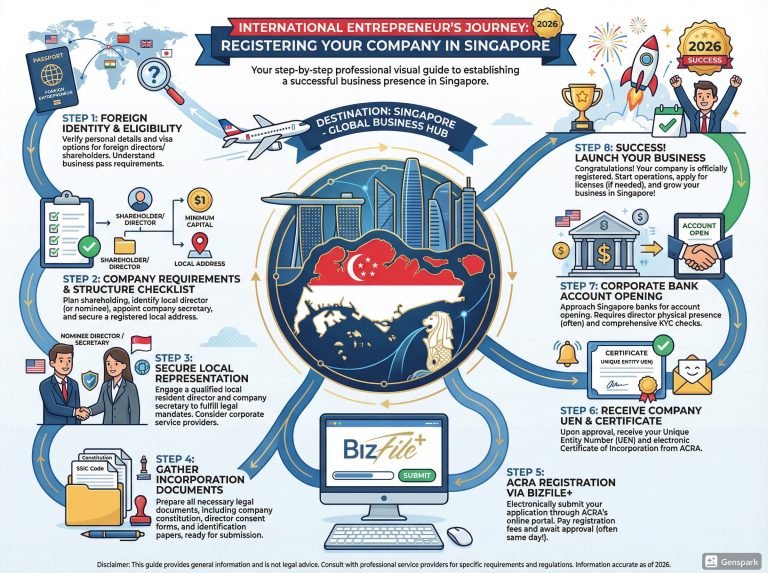
Step-by-Step: How to Register a Company in Singapore
Step 1: Name Reservation
Submit your proposed company name via ACRA’s BizFile+ system. Most names are approved within minutes unless they require manual review.
Step 2: Prepare Incorporation Documents
Required documents typically include:
Passport copies
Proof of residential address
Business activity description
Company constitution
Step 3: Appoint Officers
Appoint:
Director(s)
Company secretary
Shareholder(s)
Step 4: File Incorporation with ACRA
An ACRA-registered filing agent submits the application on your behalf. Most companies are incorporated within 1–2 business days.
Step 5: Post-Incorporation Compliance
After registration, companies must comply with ongoing statutory obligations, which are covered in our
corporate secretarial and compliance guide.
Annual filings
Statutory registers
Tax registration
Corporate governance requirements
You can read more about post-incorporation compliance and annual filings to understand ongoing responsibilities.
Opening a Corporate Bank Account
After incorporation, most foreign-owned companies open a corporate bank account in Singapore. Banks may require:
Physical presence of directors
Higher paid-up capital
Clear business substance
Preparation is critical, especially for foreign shareholders.
Employment Pass Options for Foreign Founders
Foreign founders who intend to relocate to Singapore must hold a valid work pass, most commonly an Employment Pass, subject to salary, qualification, and business profile requirements.
Common Mistakes Foreigners Make
Many foreign founders face delays due to:
Incomplete documentation
Poor business activity descriptions
Misunderstanding director requirements
Ignoring post-incorporation compliance
These issues can be avoided with proper planning and professional guidance.
Why Use a Professional Filing Agent?
Foreigners cannot self-register companies in Singapore and must engage an ACRA-registered filing agent. Many first-time founders misunderstand this requirement. Our guide on online incorporation versus ACRA-registered filing agents explains why professional assistance is legally required for non-residents. An ACRA-registered filing agent is legally required to:
Submit incorporation documents
Verify compliance
Ensure regulatory accuracy
Professional support helps streamline the process and reduce compliance risk—especially for overseas founders unfamiliar with local regulations.
Conclusion
Registering a company in Singapore as a foreigner is a straightforward and efficient process when done correctly. With full foreign ownership allowed and a clear regulatory framework, Singapore continues to be a top choice for international entrepreneurs in 2026.
However, success depends on choosing the right structure, meeting statutory requirements, and staying compliant after incorporation. With the right preparation, foreign founders can establish a strong and credible business presence in Singapore.
Businesses that prefer structured guidance may also review Singapore company incorporation services
for professional assistance and compliance support.
The information provided on this blog is for general informational purposes only and is not intended to constitute legal, tax, immigration, or professional advice. While we strive to keep the content accurate and up to date, regulatory requirements and policies in Singapore may change over time.
Readers should seek appropriate professional advice or consult relevant government authorities before making any business, legal, or compliance decisions. Terra Advisory Services and its affiliates disclaim any liability for actions taken or not taken based on the content of this blog.